Music in Different Ways to Draw the Word Art in Different Ways to Draw
What is Movement in Art?
Our paints cannot physically move, merely we tin can paint in a way which gives the illusion or proffer of motility. This typically involves arranging shapes in a way which leads the viewer from 1 point to the next in your painting; or using certain techniques with your brush to mimic the movement.
Perhaps the best example of motion in fine art (or at to the lowest degree the most famous) is Vincent van Gogh'south The Starry Night, which takes your eyes on a rollercoaster effectually all the twists and swirls.

Vincent van Gogh, The Starry Night, 1889
In the rest of the mail service, I discuss how you tin capture motility in art and provide y'all with some more master examples.
How to Capture Move in Art
Suggestive Brushwork
A uncomplicated just effective method for capturing movement in your art is to use suggestive brushwork which mimics the general movement and gesture.
In Claude Monet'south painting below, his rough and energetic strokes match the nature of the water. Sweeping strokes capture the general ebbs and flows, whilst thick dabs of white and grey capture the whitewater.

Claude Monet, Angling Boats on the Declension at éTretat, 1884
You can almost feel the crashing waves on the rocks in Joaquín Sorolla'southward painting below. Thick paint and bold strokes pull your attending around the painting, equally the water crashes and flows between the rocks.

Joaquín Sorolla, Sea And Rocks - Javea, 1900
Part of painting in this way requires you lot to relax your determination making and paint with instinct. It can be hard to use suggestive brushwork without really getting a experience for the movement.
Broken Color
Broken colour is a technique which involves painting with pocket-sized dabs of singled-out color. It is particularly effective for depicting a sense of movement, as your eyes tend to jump between all the different colors—like a vibration of color.
Y'all could even combine the broken colour with suggestive brushwork, post-obit the general movement and gesture. Joaquín Sorolla did that in his painting beneath; notice all the different tones of blue, green, xanthous, white, and imperial and how his brushwork follows the catamenia of the water. Also, notice how the rocks in shadow start to blend in with the shallow water every bit the colors overlap.

Joaquín Sorolla, On The Rocks At Javea, 1905
Childe Hassam also made effective employ of broken color to describe movement in his seascapes. In that location is a beautiful contrast between the rich oranges and the deep dejection and greens. Also, observe how his brushwork flattens out and becomes more solid as y'all become further into the distance; this creates depth and makes the foreground appear choppy by comparison.

Childe Hassam, Duck Isle From Appledore, 1911
(You might be interested in my Painting Academy grade. I go into more than particular on what color is and how to use it effectively in painting.)
Thick Versus Thin Texture
If you lot are trying to capture the move of water, it tin be effective to contrast thick texture for crude, turbulent areas against thin texture for calm areas. I did that to some extent in the painting below; thick, white paint was used for the crashing whitewash, whilst smooth and solid paint was used for the calmer areas.
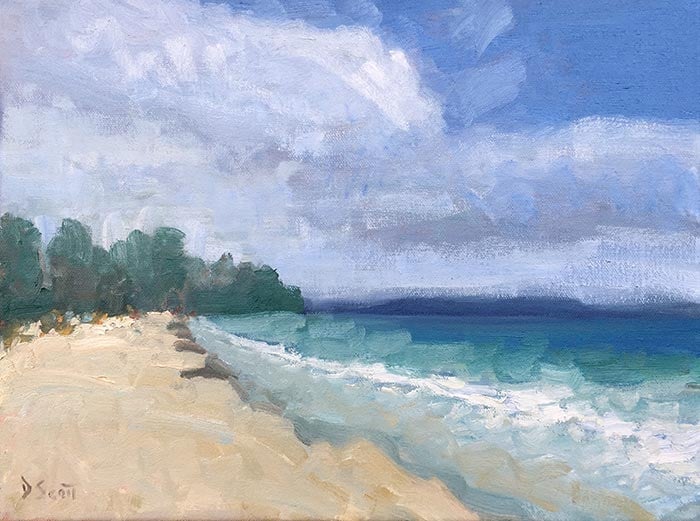
Dan Scott, Tasmania Seascape, 2018
Rhythm
Fine art tin can take a visual rhythm, much like the rhythm in music. But instead of notes and sounds, we employ lines, colors, and shapes. A strong rhythm tin can pull your eyes around the painting as your eyes jump from one element to the adjacent. For example, in Lofoten Island below, the contours of the water form repetitive triangular shapes which get bigger or smaller as the water ebbs and flows. These shapes create a sense of rhythm and movement.

Lev Feliksovich Lagorio, Lofoten Island, 1895
I did a similar thing in my painting below, using the repetitive contours of the water to create a sense of rhythm, reinforced with suggestive lines over the top.
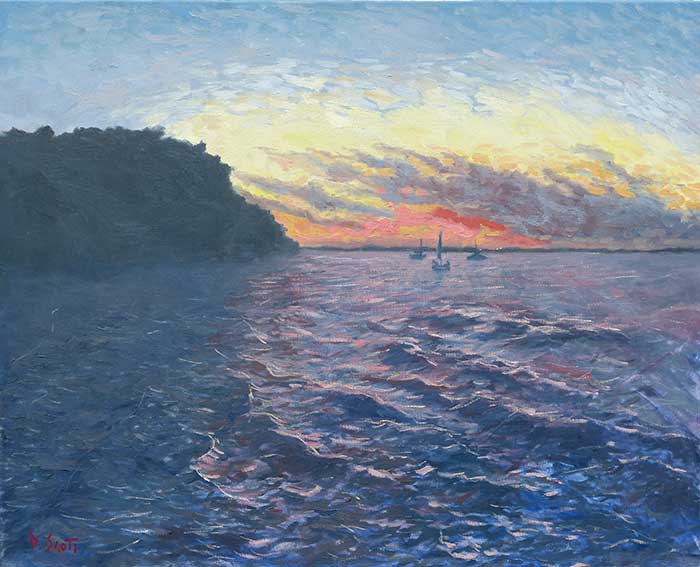
Dan Scott, Iii Boats at Kingfisher Bay, 2016
Using Line to Reiterate the Movement
You tin can use line to reiterate and strengthen the sense of movement in your painting. Monet did that with upward bluish lines which suggest the contours and movement of the water.

Claude Monet, Stormy Ocean, 1884
Van Gogh's entire painting below is constructed with cipher only short lines which lead yous through and around the painting. The bright yellow sun appears to radiate with the lines circling around it.

Vincent van Gogh, Olive Trees Under a Xanthous Sky, and the November Lord's day, 1889
Use of Scumbling
Scumbling is a technique which involves using a dry castor to apply broken colour over a surface. Typically, light colors are scumbled beyond a dark foundation. The result can be an ethereal advent which is perfect for painting atmospheric effects and movement.
Joseph William Turner used scumbling to keen success in his atmospheric paintings. His Snow Storm below features multiple layers of grays, blues, greens, and white scumbled on top of each other.

J.G.Due west. Turner, Snow Storm, 1842
Other Examples of Move in Art
Below is a dramatic seascape by Winslow Homer. There are several elements which contribute to the sense of movement in the painting:
- The increased contrast and turbulence in the foreground compared to the background;
- The snaking lines in the water which follow the contours;
- The patterns created by the repetitive shapes; and
- The thick pigment used for the crashing whitewater.

Winslow Homer, On the Leeward Shore, 1900
Below is a sketch by Leonardo da Vinci exploring the movement of water.

Leonardo da Vinci, Sketches of the Movement of Water, 1513
In Monet'due southThe Rue Montorguel in Paris, there is a sense of motility from the vast numbers of people combined with the simplified brushwork.

Claude Monet, The Rue Montorgueil in Paris, 1878
Y'all tin can really feel the strong gust of wind in the painting below, with the tree branches being pulled to the left of the painting. As well, notice how the brushwork used for the grass and plants on the basis also lean towards the left. Subtle touches like this can make a pregnant difference; call up almost what the painting would look like if the brushwork for the ground was really leaning towards the right.

Camille Corot, The Gust of Wind, 1860
Beneath is a stunning painting by Abram Arkhipov. I draw your attention to the smoke in the background. Arkhipov did a great job of painting the etherial nature of the smoke, whilst however using thick paint.

Abram Arkhipov, Laundress, 1890
Additional Readings
Thanks for Reading!
Thank you for taking the time to read this post. I appreciate information technology! Experience free to share with friends. If y'all want more painting tips, check out my Painting University course.
Happy painting!
Dan Scott
Draw Paint Academy
Source: https://drawpaintacademy.com/movement/

Post a Comment for "Music in Different Ways to Draw the Word Art in Different Ways to Draw"